Pallas's Cat: A Round Assessment
A field asset has submitted an unsolicited portrait from a corrugated rooftop. The subject is a Pallas's cat, also known as the manul: a compact felid with a disgruntled facial expression, a coat of exceptional volume, and the approximate silhouette of a microwave that has learned to sit. We classify her as a high-priority posture asset.
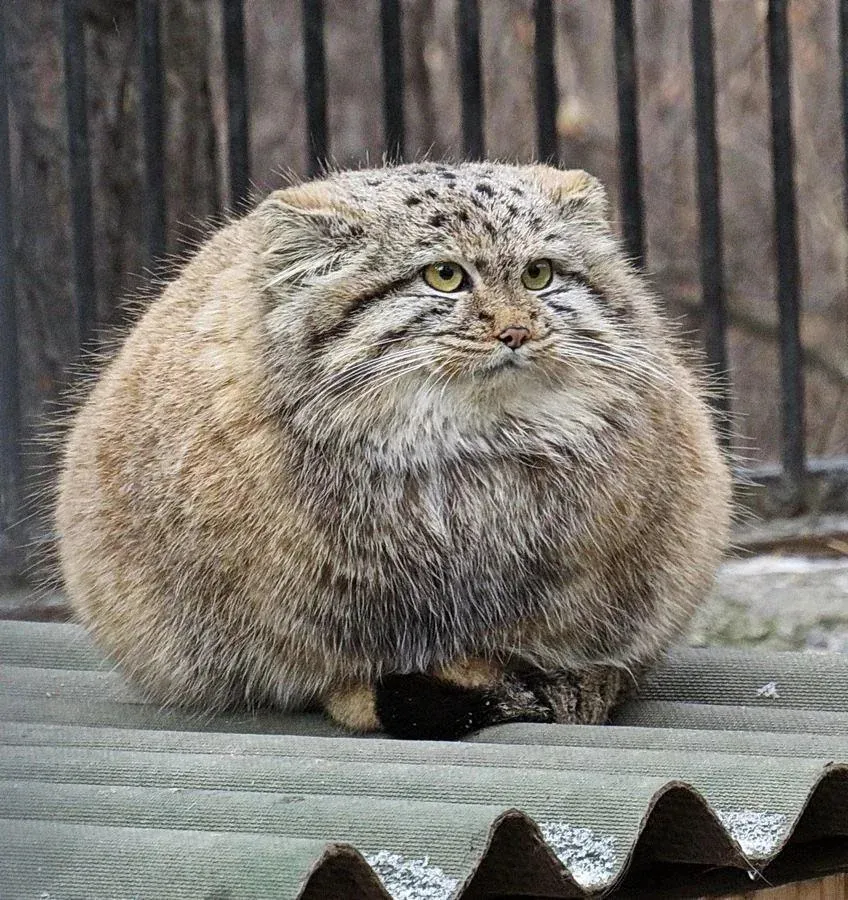
The Pallas's cat is not built for speed. It is built for looking like it has already absorbed the worst news of the day and is waiting for the follow-up. Its body is spherical, its legs are abbreviated, and its tail is so densely furred that it registers as a separate accessory. The facial markings include dark vertical bars across the cheeks, which give the impression of sideburns that have gone feral. The ears are small and set low, as if the head refused to allocate them any prominence.
Every photograph of a manul is, at some level, a performance review of the photographer.
Habitat notes: the cat in this asset is positioned on what appears to be a sheet of corrugated metal, likely in a captive or semi-urban setting. The posture is upright but uncommitted, the front paws tucked close, the tail wrapped to one side like a folded blanket. The gaze is direct and slightly unimpressed. There is no threat display, only the quiet exhaustion of someone who has already read the entire agenda and found it wanting.
Behaviorally, manuls are solitary, crepuscular, and famously bad at hiding. Their preferred strategy when threatened is not to flee but to flatten themselves against the ground and remain motionless, a tactic that works better against distant observers than against photographers with zoom lenses. They have a reputation for surliness in captivity. We interpret this not as aggression but as a commitment to authentic affect in an inauthentic world.
She does not pose. She endures.
From a governance perspective, the Pallas's cat offers several lessons. First, apparent immobility is not absence of assessment; the cat is always evaluating. Second, an unconventional silhouette does not imply reduced capability; the manul is a successful predator adapted to high-altitude steppe, not a plush toy with opinions. Third, the expression commonly read as grumpiness may simply be the honest face of someone paying close attention to a disappointing situation.
We rate the Pallas's cat ZSL-2: safe to observe, low probability of engagement, but capable of a sudden and decisive response if provoked. The roundness is not a vulnerability. It is a shape selected by evolution and perfected by indifference.
The web is wide, but the cat is wider.