World Wide Web
We call it the World Wide Web because the name promises breadth: a planet-spanning lattice of documents, routes, and endpoints, resilient by virtue of its scale. Look inside and the picture narrows. The wide room has a very small closet.
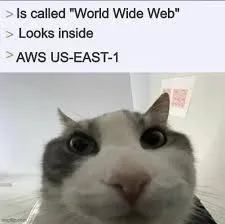
The internet was designed to survive decentralized failure. The protocols assume a graph of peers, any node replaceable, paths rerouted on the fly. That design is real at the protocol layer. It is much less real at the infrastructure layer, where a handful of cloud regions, content-delivery networks, and transit providers concentrate an outsized share of what the protocols carry.
When a major region goes down, we remember how much of the lived web was passing through it. The error pages are not distributed. They show the same friendly mascot, on the same load-balanced landing, served from the same fallback that hundreds of other services are also trying to reach. A failure advertised as "a single region" becomes visible in every country because that region was the closet where everyone hung their coat.
Resilience is a topology problem, not a branding problem.
The cat is funny because the cat is correct. The World Wide Web is called that for the same reason a mansion sounds impressive: it emphasizes square footage. But square footage is not the same as structural redundancy. If the furnace, the water main, and the electrical panel are all in the same corner, the mansion is one flooded basement away from everyone being cold.
For frontier AI work, this is especially worth remembering. The models we build are trained on distributed clusters, evaluated in containerized pipelines, and served behind global load balancers. All of that depends on the mansion's plumbing. The wide-web abstraction lets us treat geography as software, right up until the moment a single fiber cut, power event, or region outage turns geography back into a physical fact.
There is no villain here. Concentration is efficient. A few large providers can run infrastructure at a scale and cost that no individual tenant can match. The trade-off is that efficiency and resilience pull in opposite directions: the most cost-effective shape is rarely the most failure-tolerant shape, and most customers cannot afford to optimize for the latter.
The web is wide. The failure modes are local.
The appropriate response is not to abandon the cloud, any more than the cat should abandon the mansion. It is to know where the closets are, to assume they will flood, and to design as if the widest name in the world hides the smallest number of actual rooms.